Back to examples
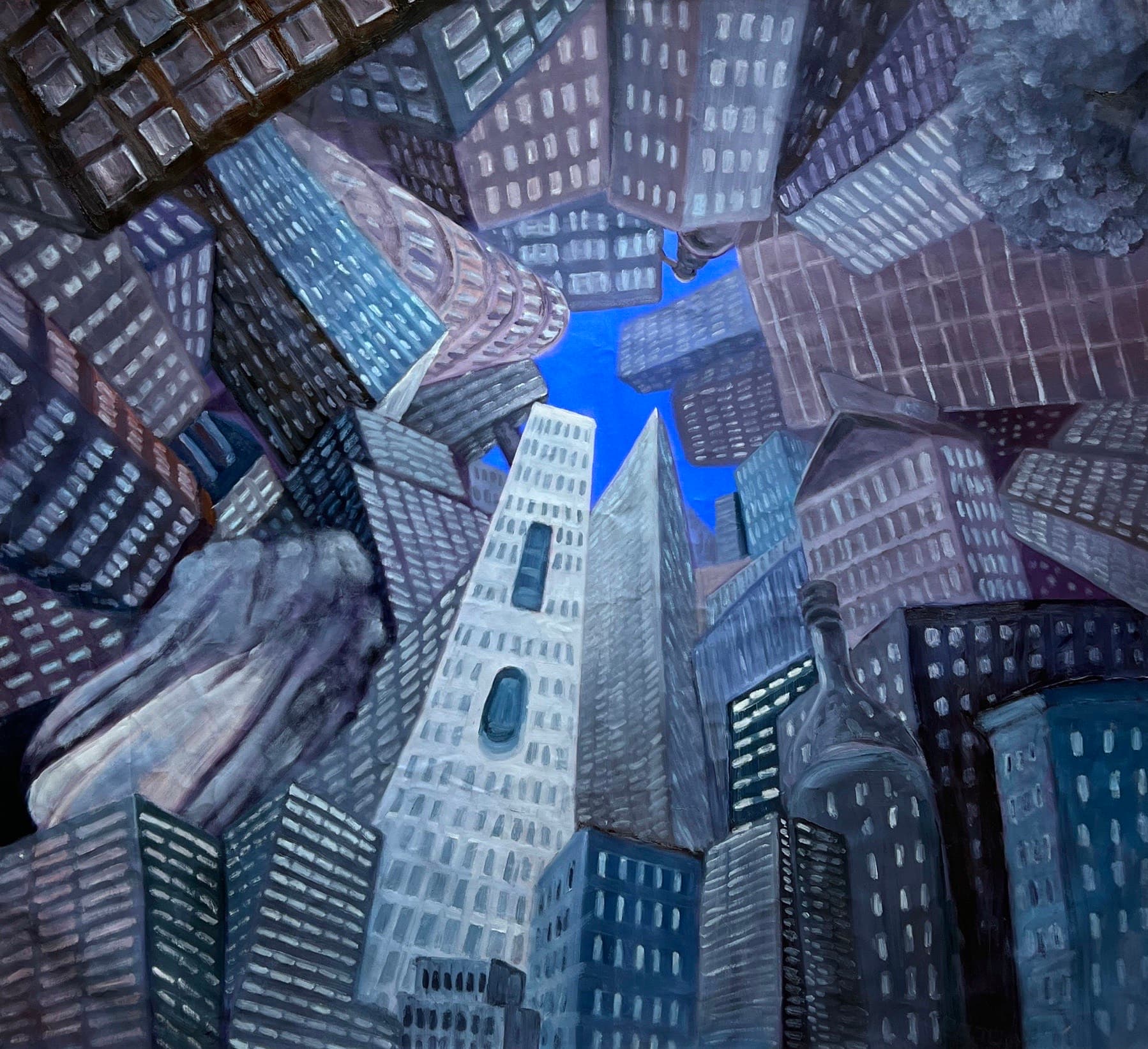
Sample artwork showing an expressive upward view of tall city buildings around a blue sky opening

A city is a well

David Luo
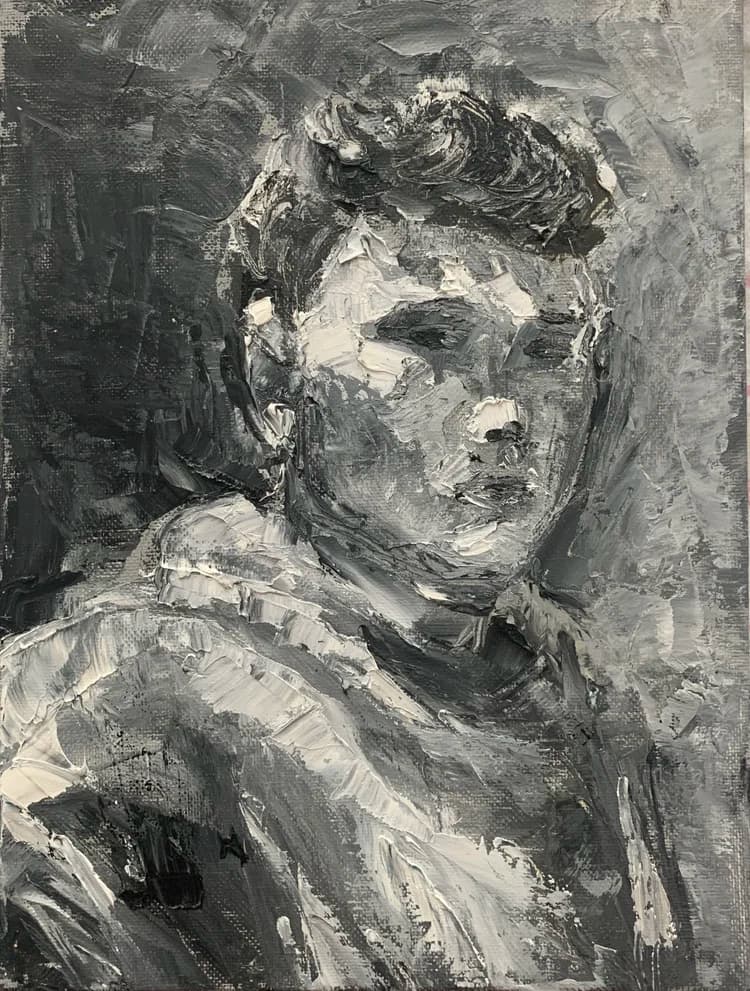
Portrait painting of Yixiang David Luo in gray tones

David Luo

Yixiang Luo is a Chicago-based artist with an MFA from the School of the Art Institute of Chicago. His recent works explore the intersection between physical urban landscapes and digital, sci-fi realms, with exhibitions at Bruno David Gallery, SAIC Art Gallery, Des Lee Gallery, Granite City Art and Design District, Monaco Art Gallery, and Graduates Art Fair in Shenzhen, China.

01 / Lens result

Visual Reading

Composition and Perspective

The artwork employs a worm's-eye view, looking upwards into a dense cluster of towering structures. This perspective distorts the buildings, making them converge towards a central, irregular patch of bright blue sky. The arrangement creates a sense of being enclosed or trapped within the urban environment, with buildings appearing to lean in from all sides.

Color Palette and Atmosphere

The dominant colors are cool blues, grays, and muted purples, which contribute to a somber or oppressive atmosphere. Strategic use of brighter blues for the sky and occasional yellow-white highlights in windows provides contrast, but these are small against the overall cool tones, reinforcing the sense of enclosure.

Form and Detail

Buildings are rendered with simplified, block-like forms, yet retain enough detail in their windows and architectural features to be recognizable as urban structures. The brushstrokes are visible, giving the surfaces a textured quality. Some buildings exhibit a more organic, almost melted appearance, particularly in the upper left quadrant, which deviates from the rigid geometry of others.

Symbolic Elements

Within the cityscape, a large, translucent bottle form is integrated into the architecture on the right side, appearing as another building. On the left, a large, fleshy, folded form, possibly resembling a hand or draped fabric, emerges from the cluster of buildings. These elements introduce a surreal or allegorical dimension to the otherwise architectural scene.

Spatial Organization and Density

The space is highly compressed, with buildings overlapping and pushing against each other, leaving minimal negative space. This density emphasizes the overwhelming scale of the urban environment and the limited view of the sky, which functions as a small, distant escape point. The varying heights and angles of the buildings contribute to a chaotic yet structured visual rhythm.

02 / Lens result

Thesis Discovery

Architectural Vertigo and the Collapse of Perspective

Evidence: The composition utilizes an extreme low-angle, multi-point perspective where buildings lean inward from the edges of the frame. The sky is reduced to a small, irregular blue aperture at the center, surrounded by dense, overlapping facades with repetitive window grids.

Interpretation: The work suggests a psychological state of entrapment within the urban environment. By tilting the structures inward, the architecture ceases to be a functional backdrop and instead becomes a physical weight that threatens to close in on the viewer. This inversion of the 'skyline' transforms the city into a subterranean or well-like structure, where the only escape is a distant, shrinking patch of blue.

The Organic vs. the Geometric Monolith

Evidence: Amidst the rigid, rectangular grids of the skyscrapers, there are several amorphous, fleshy, or smoke-like forms rendered in muted purples and greys. Additionally, a bottle-shaped structure appears in the lower right, and a dome-like, ribbed form sits in the upper left.

Interpretation: These non-architectural elements introduce a sense of biological or domestic intrusion into the sterile urban grid. The presence of these soft, lumpy forms--reminiscent of smoke, limbs, or discarded objects--implies that the city is not just a collection of steel and glass, but a site of accumulation, waste, and human presence that is being slowly compressed by the surrounding geometry.

Chromatic Isolation and Synthetic Light

Evidence: The palette is dominated by cold blues, desaturated purples, and greys, with high-contrast white highlights on the central building. Small, glowing yellow and white rectangles represent lit windows against dark, shadowed facades.

Interpretation: The color choices emphasize a sense of nocturnal alienation. The reliance on cool tones and the absence of natural warmth suggest an environment defined by artificiality. The scattered lit windows act as markers of isolated individual lives, visible but inaccessible, reinforcing the tension between the density of the population and the loneliness of the urban experience.

03 / Lens result

Constructive Argument

Compositional Ambiguity of Scale

Critique perspective: Compositional

Observation: The buildings are rendered with distorted perspectives and varying scales, appearing to lean inward and downward from the edges of the frame, converging towards a central, bright blue void. Some structures, particularly in the foreground, appear disproportionately large or small relative to their implied distance.

Critical analysis: While the skewed perspective effectively conveys a sense of claustrophobia or disorientation, the inconsistent scaling of individual buildings within the composition can undermine the visual coherence. This ambiguity makes it difficult to discern whether the intent is a literal depiction of architectural density or a more abstract, psychological landscape. The lack of a clear visual hierarchy or consistent spatial logic risks dissolving the tension between monumental architecture and the human experience, leaning instead towards a decorative pattern of shapes rather than a forceful statement about urban pressure.

Question for the Artist: How might a more deliberate and consistent manipulation of scale, even within a distorted perspective, enhance the intended emotional or conceptual impact without sacrificing visual legibility?

Materiality and Surface Logic

Critique perspective: Material

Observation: The brushwork throughout the painting is consistently visible and somewhat uniform, creating a textured surface. The depiction of windows and architectural details often relies on simplified, blocky forms and stark contrasts of light and dark, rather than nuanced rendering of glass, concrete, or steel.

Critical analysis: The consistent painterly texture, while contributing to a unified aesthetic, does not fully exploit the potential of oil paint to differentiate between the varied material properties of an urban environment. The buildings, regardless of their implied material (glass, stone, metal), share a similar surface quality. This can flatten the visual experience, reducing the tactile engagement with the depicted structures and potentially weakening the symbolic weight that distinct material textures could carry in a dense, oppressive city scene. The surface reads more as 'painted' than as 'built'.

Question for the Artist: Could varying the application of paint--from impasto to thin washes, or employing different brushwork--more effectively convey the distinct material qualities of urban architecture and amplify the painting's emotional resonance?

Narrative Integration of Anomalous Forms

Critique perspective: Conceptual

Observation: Within the dense cluster of buildings, there are forms that appear to be a large, draped fabric or perhaps a human figure partially obscured on the left, and what resembles a bottle shape integrated into the architecture on the right.

Critical analysis: These anomalous forms introduce elements that deviate significantly from the architectural theme, yet their integration is visually subtle to the point of being easily overlooked or misidentified. If these elements carry specific symbolic or narrative weight, their current rendering makes them function more as visual tangents or curiosities rather than active components of the overall statement. Their subdued presence risks making the work feel conceptually underdeveloped, as their potential to disrupt or comment on the urban landscape is not fully realized through their visual prominence or clarity.

Question for the Artist: How might these non-architectural elements be rendered with greater visual emphasis or conceptual clarity to ensure they actively contribute to the painting's narrative or symbolic intent, rather than remaining peripheral details?

04 / Lens result

Relevant References

Philip Guston

Type: Artist

Relationship Strength: ★★★

Why It Relates: Guston's late figurative work abandoned refined abstraction in favor of blunt, cartoonish, emotionally loaded imagery rendered with thick, gestural oil paint. The buildings here share that same willingness to distort architectural form for psychological effect rather than documentary accuracy. The brushwork is loose and declarative, not illusionistic, which aligns with Guston's insistence that paint carry emotional weight directly.

Specific Visual or Conceptual Link: The chunky, hand-built quality of the window grids across each tower -- painted as repeated rectangular marks rather than precise lines -- echoes Guston's late style of building form through accumulation of blunt strokes. The overall refusal of polished perspective in favor of expressive spatial distortion is consistent with Guston's post-1968 figurative approach.

Source / Citation: Mayer, Musa. Night Studio: A Memoir of Philip Guston. Knopf, 1988. Also: Storr, Robert. Philip Guston. Abbeville Press, 1986.

German Expressionism -- Urban Anxiety

Type: Art Movement / Historical Context

Relationship Strength: ★★★

Why It Relates: German Expressionist painters and printmakers -- particularly Ernst Ludwig Kirchner -- depicted the modern city as a site of psychological pressure, using distorted perspective, compressed space, and acidic or cold color to convey alienation rather than urban spectacle. The worm's-eye view here, with buildings tilting inward and threatening to close off the sky, produces a comparable spatial anxiety.

Specific Visual or Conceptual Link: Kirchner's Berlin street scenes use converging verticals and flattened, crowded figures to make the city feel predatory. Here, the buildings lean and crowd inward from all sides, the blue sky reduced to a narrow aperture at center -- a structural parallel to Expressionist spatial compression.

Source / Citation: Kirchner, Ernst Ludwig. Berlin Street Scene series, 1913-1914. Brucke Museum, Berlin. Also: Lloyd, Jill. German Expressionism: Primitivism and Modernity. Yale University Press, 1991.

Georg Simmel -- The Metropolis and Mental Life

Type: Philosophy / Social Theory Essay

Relationship Strength: ★★★

Why It Relates: Simmel's 1903 essay argues that the modern city overwhelms the individual with an excess of sensory and social stimulation, producing a defensive psychological numbness -- what he calls the blase attitude -- as a survival mechanism. The painting's composition, in which the viewer is positioned at the bottom of a shaft of buildings with no exit except a sliver of sky, visually enacts the condition Simmel describes: the individual swallowed by the metropolitan mass.

Specific Visual or Conceptual Link: The worm's-eye vantage point places the viewer structurally below and surrounded, with buildings converging overhead. This is not a panoramic city view -- it is a view from inside the well, which maps directly onto Simmel's figure of the individual submerged in metropolitan overstimulation.

Source / Citation: Simmel, Georg. The Metropolis and Mental Life. Originally published in Jahrbuch der Gehilfen-Unterstutzungs-Fonds, 1903. Widely reprinted in: Simmel, Georg. On Individuality and Social Forms. University of Chicago Press, 1971.

Charles Sheeler and Paul Strand -- Manhatta 1921

Type: Film / Visual Precedent

Relationship Strength: ★★☆

Why It Relates: Manhatta, the short film by Sheeler and Strand, used extreme low-angle shots looking up at Manhattan skyscrapers to produce a sense of monumental, almost crushing verticality. The visual logic of looking upward from street level -- buildings as walls rather than landmarks -- is structurally present in this painting, though the painting's mood is far more psychologically distressed than the film's modernist celebration.

Specific Visual or Conceptual Link: The upward-looking perspective in the painting, with towers filling the frame on all sides and sky visible only at the center, echoes the compositional strategy of Manhatta's low-angle frames, but inverts the emotional valence from awe to enclosure.

Source / Citation: Sheeler, Charles and Strand, Paul. Manhatta. 1921. Silent film, 9 minutes. Held in collections including the Museum of Modern Art, New York.

Walter Benjamin -- Paris, Capital of the Nineteenth Century

Type: Philosophy / Cultural Theory

Relationship Strength: ★★☆

Why It Relates: Benjamin's writing on urban experience -- particularly in the Arcades Project and related essays -- theorizes the city as a space that simultaneously promises and withholds, where the individual moves through corridors of commerce and architecture that are both seductive and imprisoning. The painting's well-like structure, in which the city forms an enclosure rather than an open field, can be read through Benjamin's figure of the city as labyrinth.

Specific Visual or Conceptual Link: The narrow blue aperture at the painting's center functions as the only visible exit from the surrounding mass of architecture -- a visual equivalent to Benjamin's labyrinthine city, where escape is theoretically present but structurally difficult.

Source / Citation: Benjamin, Walter. The Arcades Project. Translated by Howard Eiland and Kevin McLaughlin. Harvard University Press, 1999. Originally compiled 1927-1940.

05 / Lens result

Artist Statement

Settings
Perspective
First person
Tone
Professional

My work explores the psychological weight of the modern urban environment through exaggerated perspective and dense, rhythmic composition. In this oil on canvas series, I utilize a dramatic worm's-eye view to transform the city into a site of enclosure rather than expansion. By tilting the vertical planes of skyscrapers inward, I create a visual funnel that reduces the sky to a distant, unreachable aperture, emphasizing a sense of structural claustrophobia. The application of paint relies on a muted, nocturnal palette of blues, purples, and grays, which serves to unify the disparate architectural forms into a singular, overwhelming mass. My approach to the medium involves a deliberate tension between the rigid geometry of the grid and a more tactile, expressive handling of form, particularly evident in the inclusion of organic, smoke-like shapes and distorted objects that disrupt the mechanical order of the buildings. Through this compression of space, I aim to articulate the latent stress and sensory saturation inherent in contemporary city life, positioning the viewer at the bottom of a built environment that feels both monumental and suffocating.